Seven Small Kitchen Experiments to Build Everyday Knife Skills
Good knife skills make everyday cooking faster, safer and more enjoyable. If you are new to handling a kitchen knife, you don’t need long classes — a series of short, focused experiments will build control and confidence. Each experiment takes 5–10 minutes and uses common ingredients and tools. Repeat them a few times over several days and you will notice steady improvement.
How to use these experiments
Set a small timer, work slowly and keep safety first: a stable cutting board, a sharp knife (dull knives are more dangerous), and a non-slip surface under the board. Try one experiment per session, or mix two if you have extra time. At the end you’ll find a short 5-minute routine to practice daily.
Experiment 1: Meet the knife and learn the grip
Goal: Hold the knife comfortably and control the blade
- Pick up a chef’s knife and place your thumb and index finger on either side of the blade near the handle, with the other three fingers wrapped around the handle. This is the pinch grip.
- Practice lifting and lowering the knife slowly, feeling the balance point. Carry it only by the handle when not cutting.
- Repeat for 5 minutes, then place the knife down with the blade facing away from you.
Experiment 2: Rocking motion on a soft vegetable
Goal: Learn a smooth slicing motion
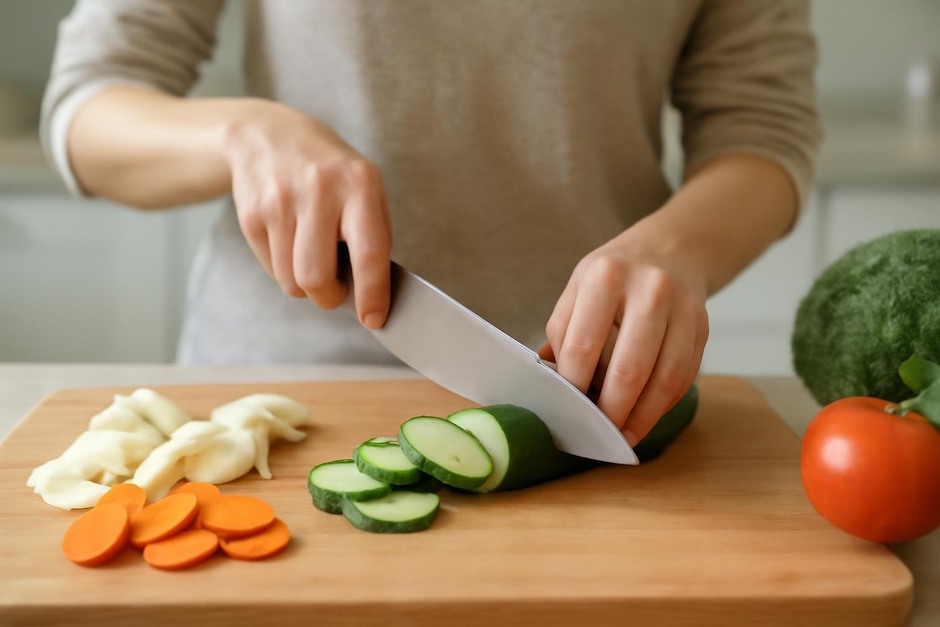
- Choose a soft vegetable such as a tomato or zucchini. Place the tip of the knife on the board and use a gentle rocking motion, moving the blade up and down while the tip stays in contact with the board.
- Keep the non‑knife hand in a claw shape to hold the vegetable steady and protect fingertips.
- Take 5–8 slow slices, focusing on rhythm rather than speed.
Experiment 3: Straight slices for even thickness
Goal: Practice consistent thickness
- Use a carrot or cucumber. Cut the ends off, then slice straight across into rounds. Try to make each slice the same thickness — aim for about 5 mm.
- Count or mark the first few slices to notice your consistency.
- Repeat until you can make six similar slices in a row.
Experiment 4: Julienne — thin sticks
Goal: Convert rounds into uniform sticks
- Trim a carrot into a short baton (about 6–8 cm). Cut thin, even slabs lengthwise, then stack and slice into sticks (about 3 mm wide).
- This builds alignment and control when working with longer cuts.
- Do this slowly for 5–10 minutes until the pieces look regular.
Experiment 5: Brunoise — tiny cubes
Goal: Fine, even dicing for recipes
- From a julienne batch, gather the sticks and cut across them into small cubes (about 2–3 mm). Focus on consistent width in both directions.
- This refines wrist control and uniformity.
- If pieces vary, return to straight slices and julienne practice briefly.
Experiment 6: Chiffonade for leafy herbs
Goal: Neat ribbons from soft leaves
- Stack basil or spinach leaves, roll them up tightly and slice across the roll to make thin ribbons.
- Use the tip-to-heel motion and keep the non‑knife hand steady.
- Practice until the ribbons look even and fragrant.
Experiment 7: Mincing small aromatics
Goal: Fine mince for garlic, shallots, or ginger
- Place a clove of garlic under the flat of the blade and press to crush, then slice and rock to mince. Gather the pieces and run the knife over them with a chopping rhythm, keeping the tip or heel on the board as feels comfortable.
- Count to 20 or set a 30-second timer and see how even the mince becomes with practice.
Short repeatable routine (5 minutes)
Choose one of the experiments and run it as a brief drill:
- 30 seconds: Grip practice — lift and lower the knife calmly.
- 90 seconds: Straight slices across a carrot or cucumber, aiming for even thickness.
- 60 seconds: Julienne or chiffonade, focusing on alignment.
- 60 seconds: Mincing or a few rocking slices of a soft vegetable to finish.
This routine is short enough to do before cooking or as a daily warm-up. Track progress by noting which experiment feels easier each week.
Final tips
Practice slowly at first. A few minutes every day is steadier progress than long, infrequent sessions. Keep your knife clean and dry between experiments, and store it safely. Over time these small experiments will become second nature, making food preparation quicker and more enjoyable.